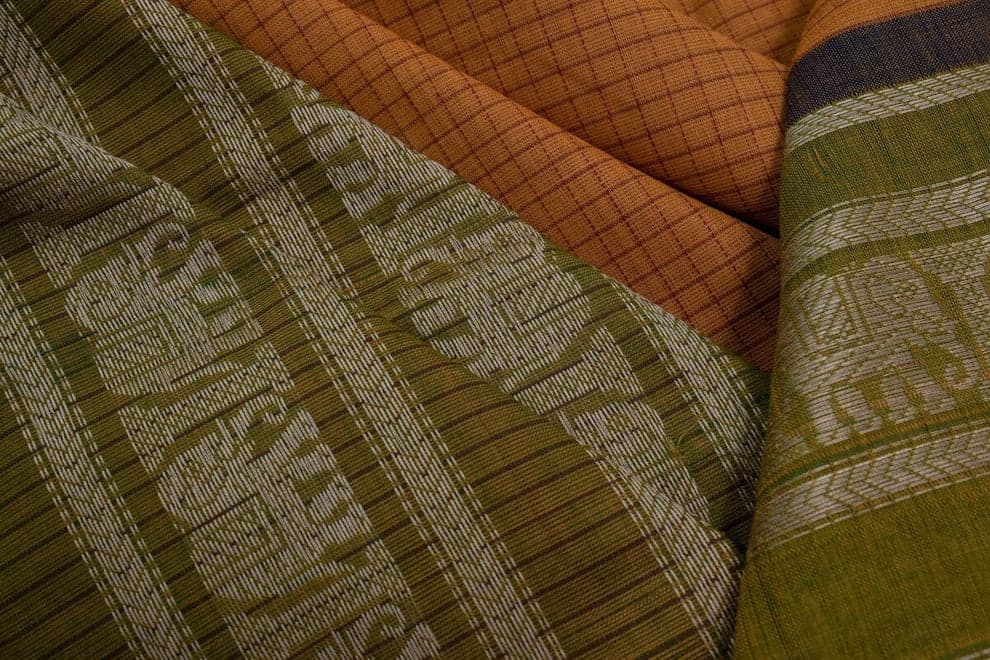
THARI has never been built around speed. It has always been built around time.
Handloom teaches patience. A fabric cannot be hurried, a motif cannot be forced, and craftsmanship cannot be measured by efficiency alone. We have chosen to grow at the pace that craft demands—thoughtfully, consciously, and with respect for everyone involved in the making process.
Every textile that enters our studio is treated as something valuable. We do not see fabric as a commodity but as the result of countless hours of skill, labour, and lived knowledge. Because of this, nothing is taken for granted.
Over the years, we have developed our own fabric library—a carefully maintained archive where every remnant, regardless of its size, is cleaned, catalogued, and preserved. These pieces eventually find a second life as textile accessories, embellishments, and limited-edition objects. It is a slow process that demands space, patience, and care, but it reflects what we believe: a beautiful fabric deserves to be used with intention.

Our commitment to zero waste did not begin as a sustainability strategy. It grew naturally from our respect for the material itself. When a cloth has travelled through the hands of a spinner, a dyer, a weaver, an embroiderer, and a tailor, it deserves to be valued until the very last thread.
The same care extends to the people we work with. Whether it is a weaver preparing a warp, a dyer perfecting a colour, an embroiderer adding the final detail, or a tailor bringing a garment to life, every person contributes to the finished piece. We believe good work begins with good relationships—with fairness, trust, and the time needed to do things well.
We do not regard these as exceptional practices. To us, they are simply the responsible way to make.
THARI has always felt less like a business and more like a community connected by craft, where every hand involved in the process is respected, and every piece carries the care of the people who made it.